
Regular Bail in Chandigarh High Court- When someone gets arrested, the first question their family asks is, How do we get them out? Here, regular bail in Chandigarh High Court becomes important.
Bail is used after a person has been taken into custody. This is different from anticipatory bail, which is sought before arrest. After someone has been remanded to judicial custody, the person can seek bail through his counsel by moving a regular bail application before the Sessions Court or a direct bail application before the Punjab and Haryana High Court, Chandigarh.
The Indian Constitution upholds the right to bail; the Supreme Court of India again reiterates the principle that bail is a rule and jail is an exception, recently through an order dated July 11, 2022, in the case titled “Satender Kumar Antil vs C.B.I.”
However, bail is not granted as a matter of right. Several factors are taken into account by the court before granting bail. The following blog explains the entire procedure for filing a regular bail application before the Punjab & Haryana High Court in simple, step-by-step terms.
What is regular bail?
Regular bail means to get relief after having been arrested. After someone is arrested, the police send the person to court. The court remands the person to judicial custody (police remand or jail). When in judicial custody, the arrested person is allowed to file for regular bail.
To sum up, it is asking the court to release you from the arrest pending the trial. This is one of the very common forms of post-arrest bail in matters related to the Chandigarh High Court. The concerned family generally gets the advocate after the arrest so as to file this application.
Regular bail can be filed at two levels, i.e., first before the Sessions Court and, if refused, before the Punjab and Haryana High Court at Chandigarh. It is filed before the said court in exercise of powers under Section 483 BNSS, 2023 (which has replaced Section 439 CrPC), and the said court does not grant it as a matter of routine.
Regular Bail vs Anticipatory Bail – Key Differences
Both types of bail protect personal liberty, but they apply at very different stages.
| Factor | Regular Bail | Anticipatory Bail |
| When to apply | After arrest and custody | Before arrest, when arrest is feared |
| Who can apply | Person already in jail or custody | A person who fears imminent arrest |
| Filed under | Section 483 BNSS 2023 | Section 482 BNSS 2023 |
| Where to file | Sessions Court or Chandigarh High Court | Sessions Court or High Court |
| Purpose | Release from custody during trial | Protection from arrest in advance |
| Common in cases like | Murder, NDPS, 498A, fraud, assault | Economic offences, matrimonial disputes |
| Custody status | The person is already behind bars | The person is still free |
| Lawyer’s role | File a regular bail application in the Punjab and Haryana High Court or the Sessions Court | File an anticipatory bail petition before arrest |
Both serve the same goal: protecting your freedom. But timing is everything. If you are already arrested, regular bail vs. anticipatory bail in Chandigarh is no longer a choice. Regular bail is the only path forward.
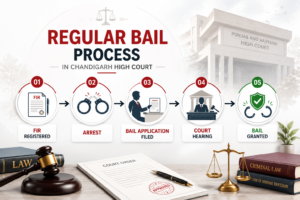
Step-by-Step Process to File Regular Bail in Chandigarh High Court
Filing regular bail is not complicated if you have the right lawyer by your side. Here is how the process works:
- Once you are arrested, police are supposed to produce you before a magistrate within 24 hours. Then the court sends you to judicial custody.
- Doing things in a timely manner is very important in bail cases. Contact an experienced regular bail lawyer in Chandigarh as soon as possible after the arrest.
- In most cases, the lawyer will file a bail application before the Sessions Court. This is a normal starter step.
- File a CRM-M petition in the High Court; If the Sessions Court declines to grant the bail, then a CRM-M petition is filed before the Punjab and Haryana High Court under Section 483 BNSS.
- The lawyer prepares a detailed petition that covers all facts of your case, grounds for bail, and legal precedents.
- Hearing before the judge, both sides argue the matter. The public prosecutor opposes bail. Your lawyer presents the grounds in your favor.
- Then the court passes the order; the judge either grants or rejects bail. If granted, a bail bond is submitted, and you are released from custody.
- If your bail is rejected, it can be challenged again after a change in circumstances or before a higher court.
Grounds Considered by the Punjab and Haryana High Court for Granting Bail
The High Court does not grant bail just because someone asks for it. It carefully examines several factors before making a decision. Here are the key grounds the court looks at:
Nature and Gravity of the Offence
This is the first thing the court checks. A minor offense like a petty dispute is treated very differently from a serious crime like murder or NDPS. The more serious the charge, the harder it is to get bail. In regular bail grounds in high court matters, the nature of the offense often decides the direction of the entire hearing.
Flight Risk of the Accused
Will the accused run away if released? The court asks this question seriously. If a suspect is a well-established resident who has family, assets, and an established position in the community or with employers, then there appears to be a lower level of risk.
Tampering with Evidence or Witnesses
The court considers whether the release of the accused is likely to compromise witness testimony or the collection of evidence. It is perhaps one of the most frequent arguments employed by the prosecution to resist the grant of bail. Where the accused is of standing or has a record of intimidation of witnesses, the court will do all within its power to protect the witness and decline the application.
Prior Criminal Record
A clean background helps. If the accused has no previous criminal history, the court views the bail application more favorably. The Chandigarh High Court gives significant weight to the accused’s overall conduct and criminal history while deciding bail.
Period of Custody and Trial Status
How long has the person been in jail? Is the trial moving forward or stuck? These questions matter a lot. The Supreme Court in Satender Kumar Antil v. CBI (2022) clearly said that prolonged custody without trial progress is a strong ground for bail. If the accused has spent a long time behind bars and the trial is still far away, then how to file regular bail in High Court, Chandigarh, becomes even more urgent for families.
Common Reasons Bail Gets Rejected
Not every bail application gets approved. Courts at the Chandigarh High Court look at several factors before saying no.
- Highly offensive crimes like murder, rape, or NDPS offenses have a higher risk of bail rejection.
- If the court feels the accused may run away or hide after release, bail is usually denied.
- If witnesses or evidence can be influenced after release, the court will not grant bail.
- A history of past offenses works strongly against the accused during bail hearings.
- If the person has been granted bail before and misused it, then the courts will also definitely reject their bail.
- If the police investigation is still active and release may prejudice it, the court may deny the application.
- In cases that disturb social peace or involve organized crime, courts are cautious about granting bail.
- A poorly drafted bail application with no strong legal grounds is one of the most common reasons bail gets rejected. This is why choosing the right regular bail lawyer in Chandigarh is very important.
- Cases under PMLA, UAPA, or NDPS have extra conditions. Getting bail in these matters requires a much stronger argument before the Punjab and Haryana High Court at Chandigarh.
Why You Need an Experienced Bail Lawyer in Chandigarh
Bail is not just a little paperwork. The way your lawyer argues your case in court can make all the difference between going home and staying in custody. At Gupta Document Centre, Advocate Amit Gupta has years of experience in criminal cases before the Punjab and Haryana High Court. The following are the things in which he will help you:
- Strong drafting of the bail petition
- Knowledge of the right grounds to argue
- Experience handling how to file regular bail in the High Court, Chandigarh
- Quick action, because delays in bail cases cost precious time